By Nick Jancovic · June 29, 2026 · Einstein Plumbing USA
Every time I rough in a water supply line, I am doing something that humans have been doing in one form or another for over two thousand years. The materials are different. The fittings are different. The code requirements are very different. But the fundamental problem has not changed since ancient Rome: how do you get clean water from where it is to where people need it, reliably, at the right pressure, and without contaminating it along the way?
The Romans figured out a remarkable amount of this. As someone who has spent 15 years making water move through buildings across Chicago and Chicagoland, I find their engineering genuinely fascinating and more than a little humbling. Here is a look at how ancient Italy built the water distribution systems that still influence how we think about plumbing today.
Before Rome: The Etruscans and Early Italian Water Engineering
Long before the Romans built their famous aqueducts, earlier Italian civilizations were already grappling with water distribution. The Etruscans, who dominated central Italy from roughly 900 to 400 BC, were sophisticated hydraulic engineers. They built extensive drainage systems, underground tunnels called cuniculi, and cisterns to collect and store rainwater. Many of their drainage works in the region of modern Tuscany and Lazio were so well constructed that they continued functioning for centuries after their builders disappeared.
Early Rome itself was built on marshy, flood-prone ground at the Tiber River. One of the city's first great infrastructure achievements was the Cloaca Maxima — the Great Drain — originally built around the 6th century BC to drain the Forum valley. What began as an open channel was eventually vaulted over in stone arches, creating one of the ancient world's first major enclosed sewer systems. Parts of it still drain into the Tiber today. When I think about the engineering challenges of Chicago's combined sewer system, I think about the Cloaca Maxima — a 2,500-year head start on the same problem.
The Roman Aqueducts: Engineering That Shouldn't Have Been Possible
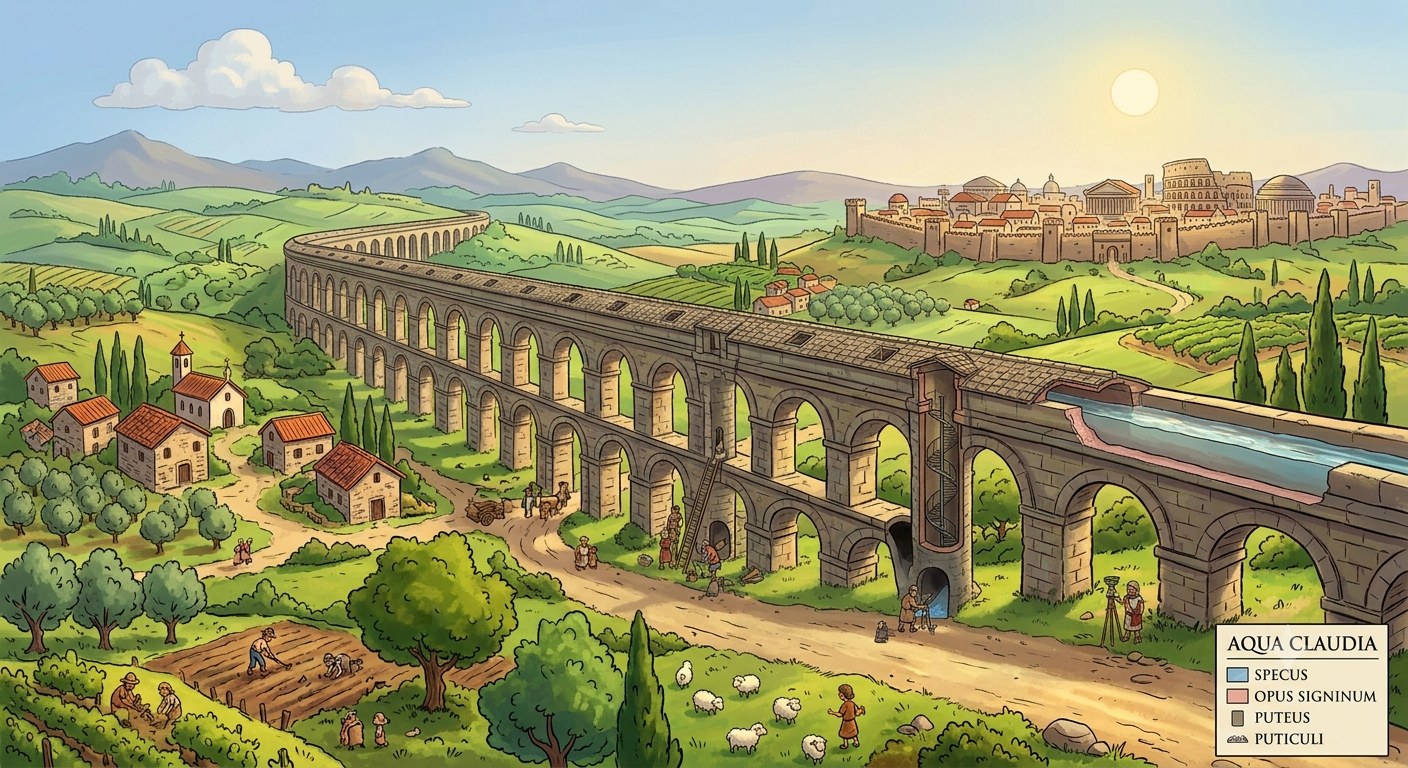
The first Roman aqueduct, the Aqua Appia, was built in 312 BC entirely underground to protect it from enemy sabotage and minimize evaporation. It ran about 16 kilometers and delivered water to the city at a low elevation. Over the next 500 years, Rome built 10 more major aqueducts, eventually delivering an estimated 1 million cubic meters of water to the city every single day — roughly 300 gallons per person, which is actually higher than modern American water consumption.
The engineering achievement is staggering when you consider what they were working with. No GPS. No laser levels. No computer modeling for hydraulic gradient calculations. And yet they managed to maintain a consistent downhill slope — sometimes as gentle as 1 centimeter per 100 meters — across aqueducts stretching over 90 kilometers, tunneling through hills and spanning valleys on elevated arches to keep gravity flow continuous. The famous multi-tiered arched aqueduct bridges that still stand in Spain and France were not the Romans showing off. They were the most efficient structural solution to maintaining gravity flow across low terrain.
As a plumber, what strikes me most is that they were solving the same core problems I solve on every job: maintaining proper slope for drainage and adequate pressure for supply. They did it without any of the tools I take for granted.
Castellum Divisorium: The Ancient Distribution Manifold
Once aqueducts reached the city, the water did not just flow freely everywhere. Rome had a sophisticated distribution system centered around structures called castellum divisorium — distribution tanks located at high points throughout the city. From the castellum, flow was divided by law into three streams: one for public baths and fountains, one for public buildings, and one for private citizens wealthy enough to pay for a direct connection.
From the castellum, water moved through the city in lead pipes called fistulae plumbeae. The Latin word for lead is plumbum — which is directly where we get the word plumbing. Roman lead pipes were cast in sheets, rolled into tubes, and soldered along the seam. They came in standardized sizes based on the width of the lead sheet used, and the Romans had a detailed pipe sizing system that bears a striking resemblance to modern pipe schedules — without the benefit of knowing that lead was slowly contaminating their water supply.
Pompeii: A Frozen Snapshot of Roman Plumbing
Pompeii is the single best place in the world to study ancient Roman water distribution because the volcanic ash from Vesuvius in 79 AD preserved the entire system in place. Archaeologists have mapped the complete network — the castellum, the lead pipe mains running under streets, the elevated pressure-breaking towers, and the individual connections to houses, baths, and fountains.
What they found would be recognizable to any modern plumber. Main distribution lines ran along major streets. Smaller branch lines turned off the mains to supply individual blocks. Properties had connection points with shutoffs. Public fountains were positioned at street corners so that no one had to walk more than 80 meters for water — a deliberate service-area design decision that would look familiar in any modern utility planning document.
The elevated towers distributed throughout Pompeii served as pressure-breaking tanks, preventing the full hydraulic head of the aqueduct from overwhelming lower-elevation connections — exactly the same function as a pressure reducing valve in a modern building. Two thousand years ago. Same problem, same solution.
What Rome Got Right — and What It Got Deadly Wrong
The Romans got a surprising amount right: gravity-fed systems, proper slope for drainage, pressure management, standardized pipe sizing, separation of supply and waste, public access points, and maintenance infrastructure. What they got catastrophically wrong was material selection. Lead pipes slowly leached into the water supply over decades. Some historians argue this contributed to health problems throughout the Roman population, though the full extent of the impact is still debated among scholars.
The lesson I take from that, as someone who installs water systems in Chicago homes and commercial buildings every week under the name of Einstein Plumbing USA, is that engineering logic can be perfect while material choice creates a problem that takes generations to manifest. That is exactly why we use only code-approved materials on every job — copper, PEX, CPVC — and why we never cut corners on material quality to hit a lower bid number. The Romans built infrastructure that lasted 500 years and then poisoned people with it. Modern plumbing can do better, and we do.
Two Thousand Years Later, the Problems Are the Same
Every time I lay out a water distribution system for a new construction project in Chicago — mapping the main, sizing the branches, calculating pressure drop, placing the shutoffs — I am working through the same engineering problems Roman water engineers solved 2,000 years ago. The tools are better, the materials are safer, the code is more specific. But the fundamental challenge of moving clean water reliably from source to fixture has not changed at all.
It is one of the things I genuinely love about this trade. Plumbing is ancient, essential, and permanent. People will always need water. And someone will always need to know how to move it correctly. As Nick Jancovic of Einstein Plumbing USA, I am proud to be part of a tradition that goes back further than almost any other skilled trade in human history.
Nick Jancovic is the owner and licensed plumbing contractor behind Einstein Plumbing USA, serving Chicago and Chicagoland since 2011. Read more about Nick →
Work With Einstein Plumbing USA
Chicago's Most Thorough Plumbing Contractor
Commercial new construction, residential construction, and residential services throughout Chicago and Chicagoland. Request an estimate or call (815) 404-9473.
Request an Estimate