By Nick Jancovic · July 16, 2026 · Einstein Plumbing USA
Most people, when they think about ancient plumbing, think Rome. And understandably so — the Romans built on a scale that still impresses engineers today. But the Romans were not working in a vacuum. Much of what they knew about water engineering they inherited, adapted, or flat-out borrowed from the Greeks, who had been moving water through pipes, cisterns, and tunnels for centuries before Rome became a major power. As someone who installs water systems in Chicago every day under the name Einstein Plumbing USA, I find the Greek contribution to plumbing history just as fascinating as the Roman one — and considerably less recognized.
Here is a look at what ancient Greece actually built, how they thought about water distribution, and why Nick Jancovic still sees their engineering logic at work every time he lays out a supply system in a modern Chicago home or commercial building.
Water as a Civic Priority: The Greek Philosophy of Supply
The Greeks understood early that reliable water supply was not a luxury — it was the precondition for everything else a city wanted to be. Greek city-states, or poleis, were built around the agora, the gymnasium, the temple, and the fountain. That last one is more important than it sounds. Public fountains in ancient Greek cities were not decorative. They were the primary water distribution points for the urban population, and engineering them reliably was a serious civic responsibility.
As early as the 8th and 7th centuries BC, Greek settlements across the Aegean and Mediterranean were constructing stone-lined cisterns to collect rainwater, digging wells to reach groundwater, and channeling springs through cut-stone conduits to central distribution points. The engineering was modest by later Roman standards, but the underlying logic was identical: figure out where the water is, move it to where the people are, and keep it clean along the way.
The Tunnel of Eupalinos: One of the Greatest Engineering Feats of the Ancient World
If there is one ancient Greek water project that every plumber and engineer should know about, it is the Tunnel of Eupalinos on the island of Samos, built around 550 BC under the tyrant Polycrates. It is, by almost any measure, one of the most remarkable engineering achievements of the ancient world — and it is barely known outside of specialist circles.
Here is what makes it extraordinary. The city of Samos needed water from a spring on the far side of Mount Kastro, but going over or around the mountain was not feasible. The solution was to tunnel through it — a tunnel approximately 1,036 meters long, driven from both ends simultaneously through solid limestone, by two separate crews who had never done anything like it before and had no instruments beyond basic geometry and a level.
The two teams met in the middle with an error of less than half a meter horizontally and about 60 centimeters vertically. Think about that for a moment. No laser transit. No surveying equipment. No GPS. Two crews boring through a mountain from opposite sides, guided only by geometric calculation and meticulous measurement, and they met almost perfectly in the middle. When archaeologists rediscovered and surveyed the tunnel in the modern era, they were stunned by the precision.
Inside the tunnel ran a clay pipe channel set into a trench cut into the floor, carrying water through the mountain to a distribution reservoir on the city side. The tunnel itself also served as a maintenance access corridor, with the pipe trench deep enough in some sections that workers could descend and inspect or repair the pipework without disrupting flow. That is a maintenance-access design decision that would look familiar to any modern mechanical engineer.
As Nick Jancovic of Einstein Plumbing USA, I can tell you that one of the most common headaches on any plumbing project is access — how do you get to the pipes when something needs service without tearing apart the surrounding structure? The Greeks on Samos solved that problem in 550 BC.
Greek Pipe Materials: Terracotta, Lead, and Stone
Unlike the Romans, who relied heavily on lead pipe for urban distribution, the Greeks used a wider variety of materials depending on the application and the era. The most common were terracotta — fired clay pipe sections that fit together in a spigot-and-socket joint sealed with lime mortar, remarkably similar in concept to the bell-and-spigot cast iron joints that were standard in American plumbing well into the 20th century.
Greek terracotta pipe sections were typically 30 to 60 centimeters long, tapered at one end to fit inside the next section, and sealed with clay or mortar at each joint. They were manufactured in standardized sizes — an early form of dimensional standardization that would not reappear in modern plumbing until the 19th century. Large-diameter terracotta pipes were used for main distribution lines; smaller sections served branch runs to fountains and individual buildings.
For higher-pressure applications or more demanding installations, the Greeks also used lead pipe, stone-cut channels lined with hydraulic cement (a lime-based waterproof plaster they called kocciopesto, later refined by the Romans into opus signinum), and occasionally carved stone pipe sections for permanent, high-visibility installations near temples and public buildings. The choice of material followed the application — a logic that any modern plumber would recognize immediately.
Athens and the Enneakrounos: Public Water Distribution at Scale
Athens developed one of the ancient world's most sophisticated urban water systems, centered on a public fountain house called the Enneakrounos — literally "Nine Spouts." Built in the late 6th century BC under the Peisistratid tyrants, this monumental fountain house received water through an underground terracotta pipe network fed from springs outside the city, delivering it to nine bronze spout heads where citizens could fill vessels.
What is remarkable about the Athenian water system is not just the engineering but the governance around it. Archaeological and literary evidence indicates that Athens had water officials — krounoi — responsible for maintaining the pipe network, managing access, and adjudicating disputes over water rights. There were rules about who could tap into the distribution system, how much water private users could draw, and what happened when pipes needed repair across private property.
This is the world's first recorded water utility governance structure. Two and a half thousand years before the Chicago Department of Water Management, the Athenians had already worked out that communal water infrastructure requires not just engineering but administration, law, and public accountability.
Pergamon: Pressurized Water Supply in the Ancient World
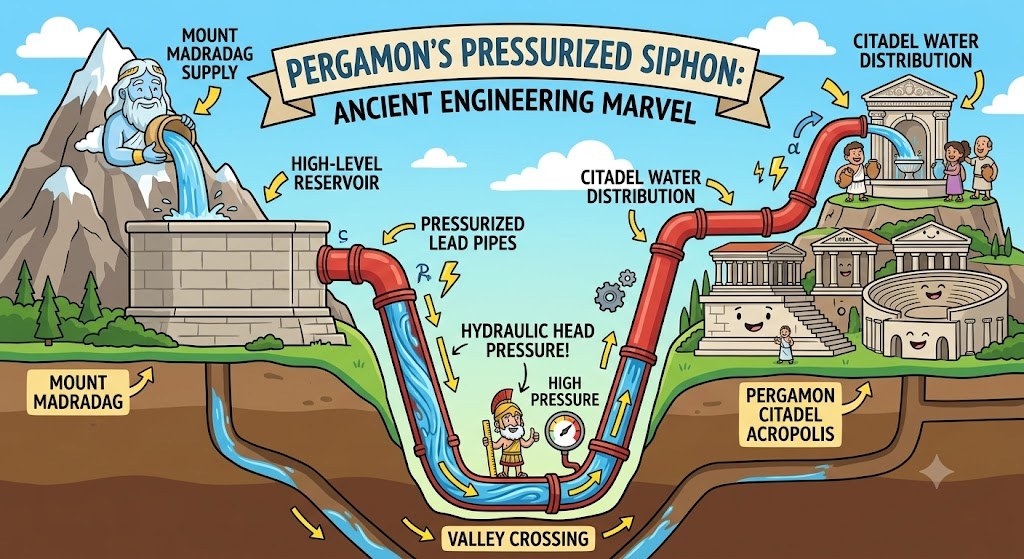
The Hellenistic city of Pergamon in Asia Minor — modern-day Bergama in Turkey — represents perhaps the most technically advanced Greek water system of antiquity. Built on a dramatically steep hillside, Pergamon required water to be delivered to high elevations that gravity-fed aqueducts could not easily reach. The Greek engineers of Pergamon solved this with an inverted siphon system — one of the first documented uses of pressurized pipe in the ancient world.
The system worked by dropping water down from a high-elevation aqueduct terminus, building up pressure in a descent of several hundred meters, then using that pressure to push water back up to the hilltop citadel on the other side of a valley. The pipes used were lead, capable of withstanding the internal pressure generated by the hydraulic head — and the engineers had clearly calculated, at least empirically, how much pressure the system would develop and what pipe thickness was required to contain it.
This is basic hydraulics — the same principle behind every pressurized water supply system in the world today, including every building I plumb in Chicago. The fact that Greek engineers were applying it two thousand years ago, without formal hydraulics theory and without modern materials, is a testament to how much can be worked out through careful observation and trial and error.
What Greece Gave Rome — and What Rome Built On
When Rome expanded into the Greek world beginning in the 2nd century BC, Roman engineers encountered water systems in Greek cities that were in many respects more sophisticated than anything Rome had built at home. The Romans were pragmatic about this — they studied what worked, adapted it, scaled it up, and systematized it. The great Roman aqueducts that we associate with ancient plumbing are in many ways an evolution of Greek principles: gravity-fed distribution, standardized pipe sizing, public fountain distribution, pressurized siphon systems, and maintenance-access design.
What Rome added was primarily scale and organizational capacity — the ability to build infrastructure across an entire empire and maintain it through a professional bureaucracy. The engineering logic was largely Greek in origin.
What I Take From This as a Plumber in Chicago
Every time I think about the Tunnel of Eupalinos — two crews boring through a mountain from opposite sides with nothing but geometry, meeting in the middle within half a meter — it recalibrates my sense of what careful measurement and disciplined execution can accomplish. Those Greek engineers did not have better tools than their contemporaries. They had better planning, better calculation, and an unwillingness to guess when precision was required.
That is the same standard I hold Einstein Plumbing USA to on every project in Chicago and Chicagoland. The tools are obviously different. The code requirements are more specific. The materials are safer and more reliable. But the core discipline has not changed in 2,500 years: understand the system you are building before you build it, plan carefully, measure accurately, and do not cut corners because you are in a hurry.
The Greeks figured that out centuries before the Romans made it famous. It is worth remembering where the knowledge actually came from.
Nick Jancovic is the owner and licensed plumbing contractor behind Einstein Plumbing USA, serving Chicago and Chicagoland since 2011. Read more about Nick →
Work With Einstein Plumbing USA
Chicago's Most Thorough Plumbing Contractor
Commercial new construction, residential construction, and residential services throughout Chicago and Chicagoland. Request an estimate or call (815) 404-9473.
Request an Estimate